
Tre Carroll Scouting Report
As a creating + scoring wing, Carroll answers a need for positional size, depth + role versatility has him on NBA radars. He'll be undrafted, but will sign a deal regardless. Here's all you must know:
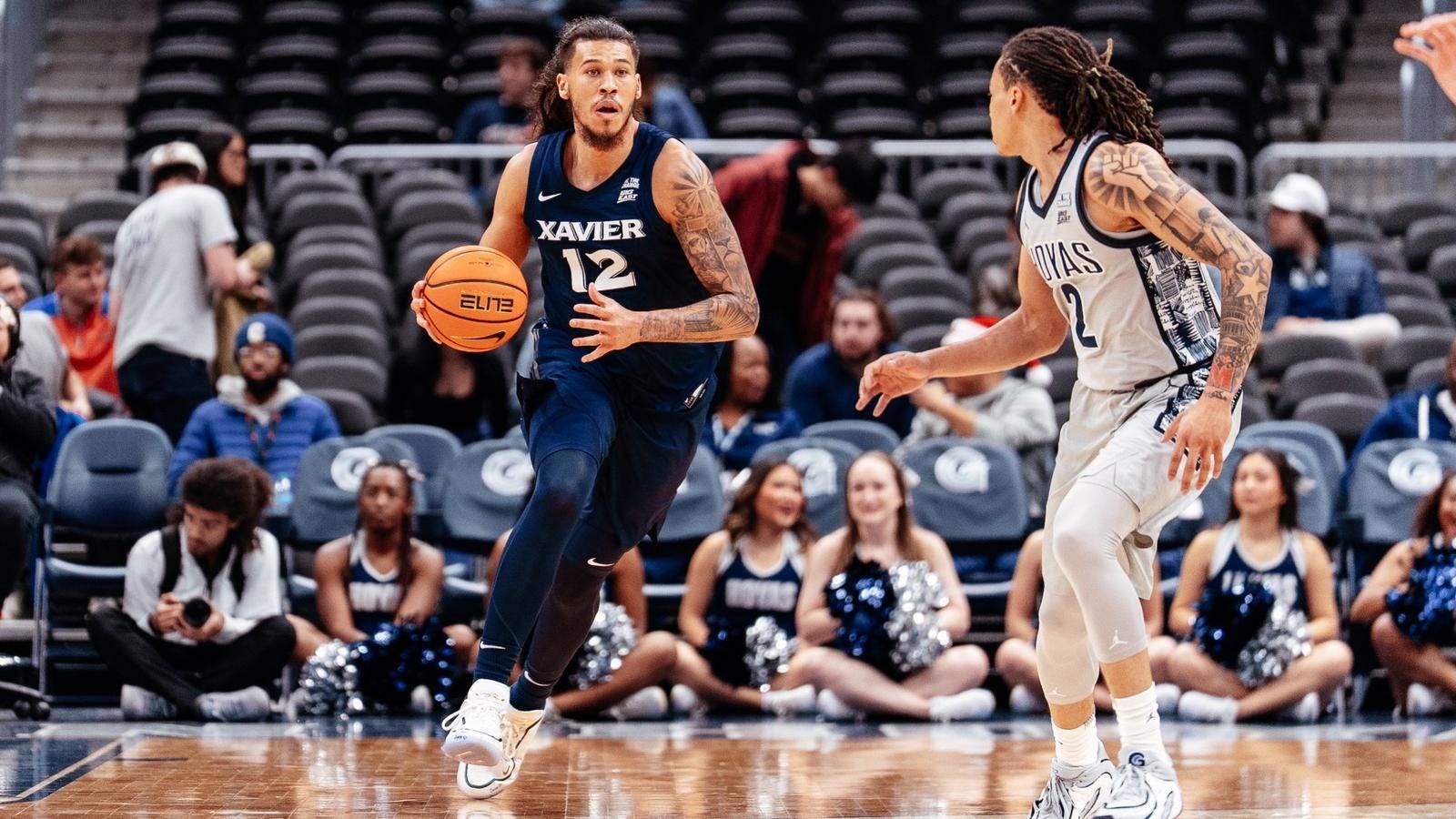
#12 Tre Carroll, Xavier: Senior, 6’7”
Small Forward — Born: Apr 16, 2003 (23 years old)
Introduction
At 17.8 points per game, Tre Carroll earned All-Big East honors after another All-Conference season at Florida Atlantic as a junior. His scoring prowess, positional size, role versatility and high level of skill was the reason I put him on my watchlist this summer. After his performance at Portsmouth Invitational, he continued to impress and will likely have many workouts with NBA teams before the draft.
Prospects like him manage to find a spot to keep in contention to stick in the league. Defensively there are some lapses to overcome, but I’m still convinced he’ll carve out a role off the bench. That’s the emphasis of this scouting report.
Physical Profile
At a official 6’7.5” measurement, Carroll’s positional size, strong upper body and fluid hips are the main traits of his physical profile. He has an NBA ready body at 248 pounds, where his game is built more on finesse, brute strength and footwork rather than relying on burst, speed or quickness.
He’s a decent athlete laterally, with surprisingly well vertical pop for his build. At 6’11”, his length is another value-increaser, whereas he’s combining ball skills with physicality on the floor, fitting him well to a more physical NBA game.
At over 350 (!) articles in 3.5 years, Ersin’s NBA Draft Newsletter is your go-to for draft content. Make sure you subscribe at $6 per month/$60 per year for much more!
Defense
Pick-and-roll
Carroll’s sliding his feet decently, but lacks the true burst to answer against smaller and quicker ball handlers. His size helps him to play the second line where he’s comfortable to defend the perimeter as well. The first play has him show his composure, moving his feet comfortably before recognizing the pull-up jumper with a strong contest. However, the other side of the coin is the lack of good screen navigation which led to him running into the wall in the second play and losing valuable space to box out for the defensive board.
The tagging is a vital part of him keeping control. The third play has Carroll refusing to give the roller the space for his cut, tagging, stepping back and immediately taking the switch when seeing the ball screen. His shot contest was in space, but still a strong one. Him sprinting to the other side for a potential quick finish is another high-feel type of play. The fourth play has Carroll lose the speed battle, but his feel for positioning was solid, which eventually led to the missed layup. Him hitting the deck is a sign of his footwork still needing to improve, which is the main area of attention for the next few years. That last step is not consistent enough.
Regardless, Carroll has shown that he can defend in the pick-and-roll, adding a blend of role versatility with his bulk and strength fitting to stop rolling fives whereas his footwork is decent enough to pick up ball handlers who are seeking angles to attack.
Closing out
At under two fouls per game for his entire college career, Carroll’s showing good returns. He’s playing under control, but still shows the toughness to succeed. He’s not a fast prospect, but positioning-wise the game has slowed down for him in the last two seasons. The first play has him show a wide stance, limiting angles to drive in the closeouts and forcing the ball handlers to try and beat him off speed. That’s been the case. The lack of burst is getting worse when considering the footwork that needs some areas in cleaning up. The first play has him use the emergency brake when the scorer still got the open layup after he closed the lane so well. The outcome is similar in the second possession, early physicality but still getting beat off speed when closing out.
In the NBA it won’t be much different than that. Overall, that’s okay to a certain degree because the physicality and toughness are positives. But the lack of speed is the main issue with the third play showing another example. Playing a heavy-drop or allowing closeout scorers more space is his way to hedge his chances. The closer he gets to more explosive defenders, the more pressure it puts on his defense, and that’s the part where NBA scouts will worry how much he’ll cost a team’s defensive rating with him on the floor.
Cuts and defending away from the ball
This puts much more weight on his ability to close lanes, rotate timely and be factor in limiting angles to cutters. That’s the best shot for Carroll to answer the NBA’s glaring need for more ready rotational pieces out of this senior class. However, there’s a degree of reactivity in his game to where he’s mostly reacting on what happens, than having full control over his assignments while limiting angles to cutters. The first play has him rotate in a place where he should have sticked to the play-finisher on the weak side. That’s the missed read that led to the easy points, whereas the second play has him waiting for the dropoff pass, instead of limiting that passing angle to where the third possession was the most clear drop-off pass after pressuring the defense.
Showing better decision-making in these plays is the main area to focus on for him. The fourth possession has Carroll ignore the weak side to deal with the dropoff pass in the middle. He was on time, but the lack of toughness on that play caught my attention. Overall, Xavier was not a good team defensively, so the context isn’t the best in his case. Regardless, the defense away from the ball has been below-average during his senior campaign, which puts another challenge on how much NBA teams will trust him early in his career to put him on the floor consistently.
Subscribe Now!
Offense
Catch-and-shoot
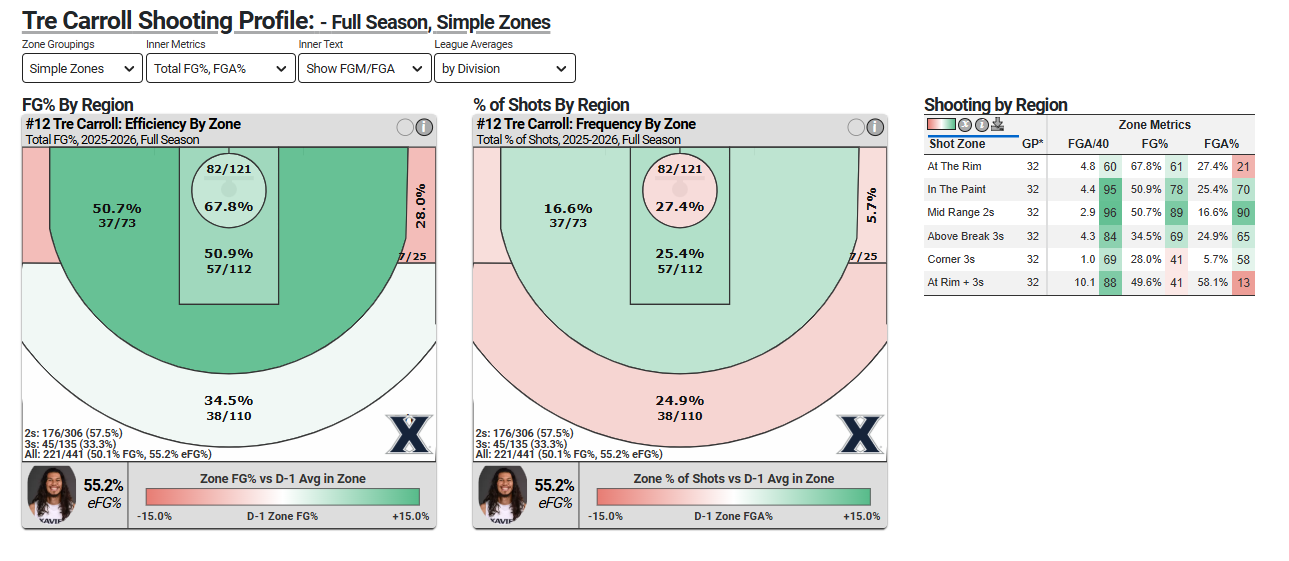
Carroll has been a low-volume shooter before enrolling at Xavier. So the 33.3% on 4.2 attempts per game is decent at first glampse. He has a decent shot process where he length and size helps him to get over the top of defenders, whereas his release point is lower than what I anticipated to see. The first play shows him play with his feet to sell the defense the closeout attack before taking the NBA-ranged jumper. That’s a vital part, as 100% stationary shooters have zero to no value in today’s league. There has to be a form of a threat, and in Carroll’s case it’s his crisp interior scoring that puts some more gravity on his decent three-point shooting.
He’s bending slightly backwards on his jumpers instead of a full 180 degree angle. The second play with the transition three shows a good example. He has a good form and shows some quick-trigger motion with the third possession as an example. Overall, Carroll’s shooting at Xavier hasn’t been at a level to where that can be his calling card in the NBA. Regardless, at 135 attempts he shot more as a senior than his previous three years combined. That’s the context for the NBA, as he’s still getting accustomed to a increased volume. He’s a willing shooter with deep range, and that’s a threat if he’s using his jumper to pass more out of defenders committing to him.
Overall, it’s been mostly focusing on his misses so far. He’s quick in his execution and that’s the base for his success in the NBA. But the process as a whole needs some adjustments in the next few years.
Self-creation out of closeouts
This is where Carroll’s value for the NBA comes from. He’s at over 50% from the midrange and close to 65% at the rim without dunks. The combination of both make it a tremendous return. He’s a true scorer and advantage creator in tight pockets, mostly playing his finesse game, using his brute strength to get advantages. Great use of force to power his way to the paint from the elbow.
Regardless of that missed shot, he’s looking to immediately punish smaller defenders by hunting these mismatches, where Carroll could have brought the ball to the paint, elevating from both foot at a short range from the rim. The best part is that defenders know how physical he is, so the jab step Carroll threw in the second play was obvious and he still had the defender’s reaction before luring him into the and-one motion where the defender pulled the emergency brake. At 70.9% on 3.7 free-throws per game, he has shown good returns.
The most vital part is that Carroll’s touch is solid, but he will rush into finishes when he’s not finding the advantage on his last step. The fourth play shows a good outcome after attacking the clsoeout from the corner, with a similar outcome in the fifth possession. By being physical against Carroll, his lack of speed gets exposed but the positive here is that he’ll find the angle with his fluid hips, but to a degree where he should prioritize passing out of his last step more often. That’s the area of attention for the next few years.
Passing, ball-moving, and playmaking
This also led to the small number of assists per game at 2.6. But at 2.2 turnovers, he’s still showing good returns. The issue is the lack of passing out of his advantages, but the big context here is that Xavier ran a lot through Carroll for their offensive rating to work. In the NBA he’ll have a reduced role to where he’s forced to get rid of some of his tunnel vision and a active passer, ball-mover and additional playmaker alongside ball-dominant players around him. He’s decent at executing his reads as well. The first play has him demand all attention in transition before seeing the cutter on his right. The second play has him again pressure the rim to where he puts the ball in the corner, but the lack of looking around him for another angle with two defenders committed was something that shows he’s not been put in that playmaking position as much as he should have been throughout his career.
Regardless, his composure and calmness as a passer stood out immediately. The third play has him trapped in the corner and he’s looking for the angle with the impressive kickout to the opposite corner as a result. That’s a high-end play as composure is a big part of playmaking skill. However, he’s mostly been used as a ball-mover, which should be most of his responsbilities in the NBA. The fifth, sixth and seventh plays below show good examples. Overall, Carroll is a basic playmaker who can execute reads and add additional ball skills to a NBA roster. That’s the passing versatility he should continue to add to in the next few years.
NBA Draft Projection
The positional size, ball skills and NBA ready body are the clear positives. His efficiency from inside the lane is a result of self-creation as more of face-up-scoring bully who hunts mismatches while his footwork and creativity is decent enough to continue to add value. He’s limited as a playmaker, but there are enough flashes for him to continue to add more different ways to use his physicality to carve out a niche role in the league.
However, defensively there are too many lapses to overcome, with the common denominator being the lack of burst, speed and lateral pace. That’s to a degree where NBA teams will struggle to keep their defensive rating at par with him on the floor. Overall, Carroll’s added value is mostly on the offensive end, but where teams will gladly bring him in for workouts while looking to add him to their G League affiliate. I believe in Carroll landing a Exhibit 10 deal right after the draft as a undrafted free agent.
At over 350 (!) articles in 3.5 years, Ersin’s NBA Draft Newsletter is your go-to for draft content. Make sure you subscribe at $6 per month/$60 per year for much more!