
Stefan Vaaks Scouting Report
As one of the best offensive engines in college ball, Stefan Vaaks' potential to play in the NBA has to be investigated. Here's my in-depth scouting report on his future role and long-term potential:

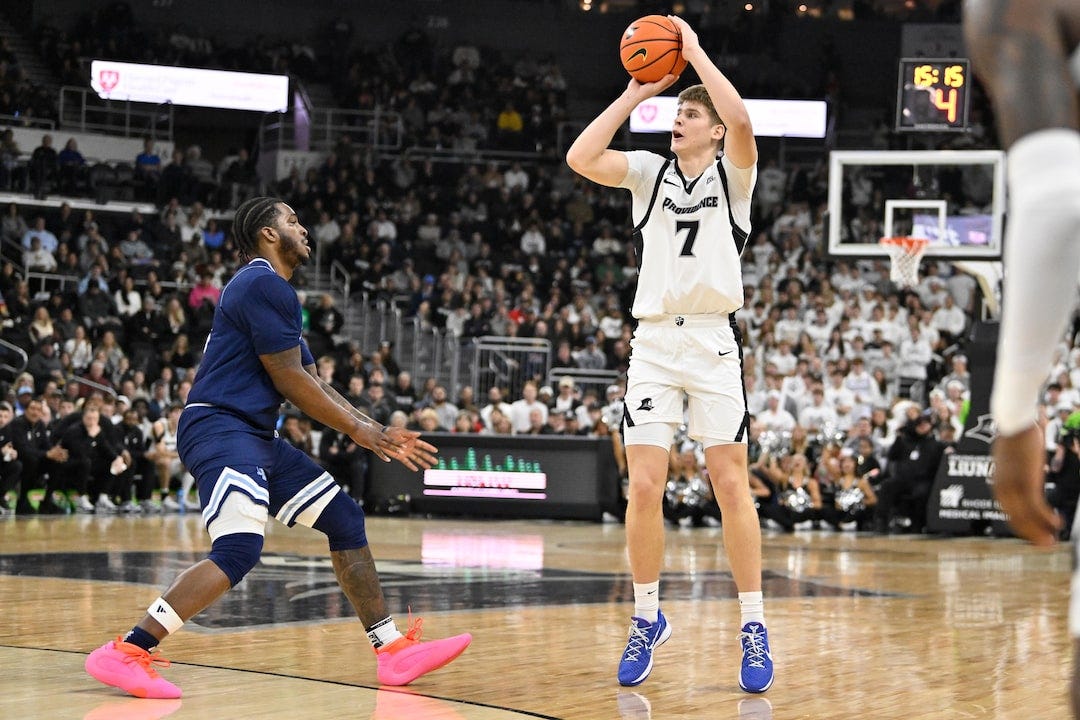
Stefan Vaaks (#7, Providence): Freshman, 6’7”
Shooting Guard/Small Forward — Born: May 8, 2005 (20 years old)
Introduction
First of all, let’s give credit where credit is due. Providence’s coaching staff did a tremendous job in finding Vaaks, who was a top European reruit hiding in plain sight. As one of the better prospects from the Baltics, Vaaks has more than sixty games on his resume as a teenager in the Estonian Latvian Basketball League, where he played games in the FIBA Europe Cup as well, the fourth-tier international league in Europe.
As a gifted ball handler and shooter, the years of experiene is seen in how strong Vaaks is in playing the angles, and staying calm and patient. His game is entirely built on the idea that substance prevails over flash, and that’s where he has demanded the respect of being the team’s leading ball handler as a teenager, putting up back-to-back fifteen-point-plus seasons before committing to the Friars, where he’s a double-digit scorer so far this season.
This scouting report is focused on Vaaks’ NBA role while highlighting the long-term potential as well.
Physical Profile
At 6-foot-7, the Estonian-born is a solidly-built guard in a wing’s body. He’s a good athlete with strong and crisp footwork, showing decent lateral quickness. He’s not explosive in terms of speed of with good verticality, but he’s making up for it with his strength and great understanding of angles. With fluid hips, Vaaks continues to master his body and improve his mobility.
While listed at 212 pounds, Vaaks can continue to bulk up and fill his frame. His game is not built on using speed or quickness, putting extra pressure on him being physically ready to handle contact consistently. It helps that he has a great core. He also has a good motor and plays with the natural toughness that NBA teams seek.
At over 275 (!) articles in 3 years, Ersin’s NBA Draft Newsletter is your go-to for draft content. Make sure you subscribe for much more!
Defense
Pick-and-roll
Let’s start with the areas that need work. Vaaks is not a good screen navigator and he struggles with the awareness of incoming ball screens, leading to him giving up separation often while allowing ball handlers to pressure and collapse the interior defense. However, there are some positives to this part of his game that makes it feasible that he’ll improve in the next few years. He’s an active tagger and has a strong last step. The first play shows an example. We see a ball screen placed that serves as a wall, forcing Vaaks to throw himself between the screener and ball handler. That’s a decent execution on his end, as he pivoted strongly helping him to not hit the deck after he hit the screener’s leg. He kept an active tag and used his length in contesting the shot. What would have been a wide-open stepback was a contested shot due to Vaaks’ effort and strong tag.
However, the decision-making is not consistent. The second play shows a high ball screen where he has to drop and dodge the screen in all occassions. The screener made him fight through the screen and with a wide open interior, the driving lane was completely there for the ball handler. If he’s dropping and dodging the screen, he’s either forcing the ball handler to shoot early, pass out while he could keep him outside the interior, with his dropping five man being there to strengthen the rotations inside the lane. The third play has the ball handler in trouble, and that’s where the lack of composure kicks in. Vaaks is too reactive and shows it with how he’s moving his arms to reply to the fakes and jab steps. Regardless, the screener comes and it doesn’t lead to a downhill drive with Vaaks showing a good shot contest in the corner.
The common denominator in all plays is a lack of navigating the screens, where Vaaks often folds because he’s fighting through all screens, and not dropping or finding ways to navigate around them. That’s an area of attention in his profile.
Closeouts
Footwork prevails. That’s the emphasis in Vaaks’ role and style of play. That’s helping him to be effective as a closeout defender. He’s sliding his feet very well, and combined with his good core and fluid hips, he’ll be comfortable making a difference in closeouts.
The first play shows an example. He starts with helping timely on the dribble penetration from the elbow, pivoting strongly with his left that helped him recover and close out to his own assignment. Strong last step before he’s keeping his balance and matches the pace of the dribble penetration. He kept the scorer in front of him purely based on footwork, not relying on speed or whatsoever to eventually come up with the block after keeping the angles closed. We see a similar outcome in the second possession. Strong last step and slides his feet quickly to close the driving lanes while ensuring the scorer has to collide and force contact to get his feet in the paint. That led to the unbalanced midrange jumper with a good contest on Vaaks’ end.
However, the main area of focus is for Vaaks to keep his feet inside the lane. Similar to in the pick-and-roll, it doesn’t matter how far he has to go, he’ll try and go over and not play drop. The third play shows him miss the last step with lots of space behind him. That’s what led to the interior defense collapsing on the pressure. Similar outcome on the fourth possession. There’s no need to trap the ball handler like that, as the baseline was already closed while Vaaks forced him to drive into the strong side. His last step was good in terms of how he placed it, but the positioning was not good and led to another dribble penetration with him getting beat off the dribble.
Playing with giving scorers a bit more space will lead to Vaaks not bailing out ball handlers anymore by giving away driving lanes. The footwork is good, the physicality he forces is good as well. But now it’s all about building consistency in making the right decisions on how far he’s closing out. Regardless, this part of his defense is promising and imminent for improvement in the next few years.
Post-ups
Vaaks plays tough and doesn’t shy away from physicality even if he’s matched up against bigger and stronger forwards inside the lane. The role versatility is one of the key differentiators between him and many other offensive engines in this class. That’s why post-up defense matters in his evaluation. Vaaks uses his size well to offer defense inside the lane. He’s not fully developed his upper body strength and still has room to fill his frame. That’s visible on the floor as well. The first play has him doubling the post scorer to take away the bailout pass, before he’s rotating to the weak side play-finisher. The second possession shows him being overwhelmed with the level of contact he had to endure in his chest, leading to him allowing the post scorer to get both feet inside the lane, spin and finish over him.
Closing angles when that level of strength difference occurs makes it an area of attention where teams must help him bulk up gradually if defending forwards becomes one of his defensive duties. Positioning in post-ups need work as well, as Vaaks was locked when the forward positioned himself closer to the rim, demanding the bailout pass while Vaaks was kept in position due to the level of strength difference. However, when matched against guards or wings, he’s much more comfortable, but that’s where he gets too reactionary. It’s understandable, as expanding his range of defense to forwards is a pure bonus in his profile, but the level of toughness and not shying away from the strength difference speaks volumes to how he’s approaching the game. On top of that, he’s averaging less than two fouls per game so far this season.
Subscribe Now!
Offense
Shooting off the catch
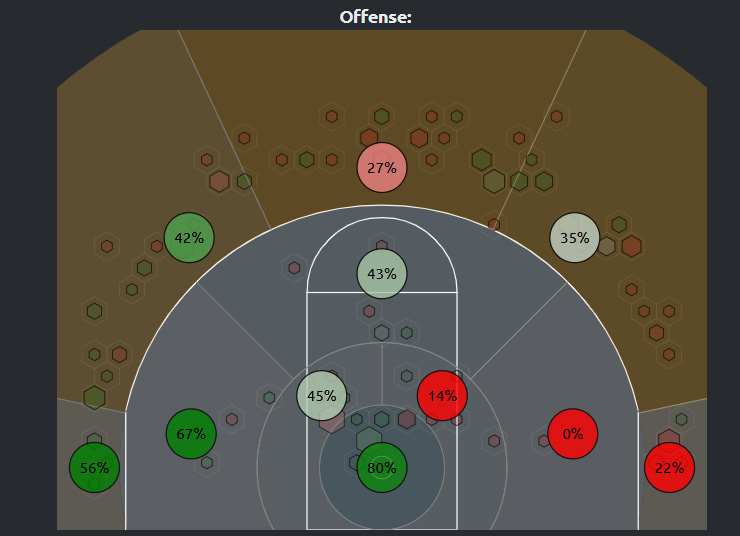
Vaaks’ role is primarily to offer high shooting value. He’s excellent both stationary and off the dribble. Great body control and quick feet help him to keep his consistent shooting form sustainable. He’s converting 35.5% of his 7.6 attempts per game. That’s great value, clearly improving a team’s offensive rating when considering points per possession. The vital context is that his jumper is the opponent’s first thing to focus on in his scouting report.
Therefore, everything above one point per possession is taken with the greatest joy. Vaaks has a nose for creating space and better angles to shoot, whether it’s stationary or after one or two dribbles. He’s a great cutter and off-ball mover. The first play shows an example of him getting wide-open above the break when his team loads up the strong side. However, the decision-making is often lacking. He’s too much focused on getting his jumper up instead of considering the extra pass. With them loading the strong side up, every shooter has to check how the weak side looks, and that’s where a teammate was relocating to, demanding the ball. With the quick closeout, passing up a good shot for a great shot matches what all NBA teams are trying to accomplish. That’s the other side of the coin when considering his high volume, as Vaaks has to keep the passing option open at all times.
Regardless, he has a quick process, even though he’s lowering the ball to under his waist on the catch. That’s not necessary. He can keep the ball higher as he’s strong enough to not needing to power up so far from his knees. The second and third plays show examples. He can keep the ball around his chest and speed up his release. The feet are quick and the balance is perfect while keeping the rim at 180 degrees. That’s why focusing on his misses to see what went wrong is the main emphasis here. The fourth and fifth play show the shooting consistency in his form and release. That’s high level stuff, especially if he can sustain the volume he’s enjoying this year at Providence.
Creation out of pick-and-roll
The lack of burst and true speed is telling when looking at Vaaks in the pick-and-roll. He’s mainly seeking to shoot off the dribble, not getting downhill consistently. To ensure he’s finding the space and balance for his jumper, being too physical would not benefit that process either. That pushes me toward the conclusion that it’s best for Vaaks to not be considered a guard at the next level. He’s shooting threes on over 70% of his total attempts. On top of that, movement patterns and instincts focus on getting toward his shot rather than creating separation and score inside the lane. That’s perfect to scale his role down at the next level, which is very likely going to happen anyway.
His potential to grow as an interior scorer is more wishful thinking rather than substance. That’s okay, as he doesn’t have the tighest handles nor the creativity to rely on his craft and strength to find separation in tight pockets inside the lane. The first three plays show him playing the pick-and-roll to end up with his three-point shot. The process is decent, but not feasible to succeed in a more physical NBA style of play.
Slashing and making plays out of closeouts
To keep the leverage and gravity of his jumper, Vaaks has to show that he’s an effective scorer in closeouts. That’s a part of his role that’ll lead to his contributions to his team’s offensive rating. That’s where he’s showing inconsistent returns so far this season. The first play sums up everything. Vaaks has to burst to rely on when he’s driving to get to the rim. Therefore, timing on his drives and immediate physicality is a must for him to keep relying on his craft. He’s often trying to bail himself out, with an effective fake from NBA range to where he tried to draw the deep foul. The shooting gravity is a big part of why he’s such a threat at the collegiate level. Teams isolate him and that’s why he’s often put in a position like that. But that’s where it’s essential for him to pass out of the play when it doesn’t benefit his team. That’s how he’s not optimizing his team’s offensive rating. In crunch time, it’s inexcusable to have an airball from that far.
But on the other hand. The shooting gravity and prowess is so lethal that it opens up everything to continue to fake defenders and collapse the defense. He’ll shoot more often than not, but the second and third possession has him with the wide-open three while he’s still surveying the possible pass if more defenders collapse on him. On the other hand, the craft decent as well. When the driving lane is there, good footwork and resilience to get downhill puts him in a good spot to get both foot in the paint. He has good touch around the rim, but he’s struggling to get their in bunches. At 60.7%, the returns around the basket are decent, but still in for improvement.
Passing, ball-moving, and playmaking
At 3.3 assists per game, the returns on that end are underwhelming considering the number of ball touches in a game and visibly not prefering passes over his own jumper. In terms of executing his passing reads, Vaaks is one of the better Europeans that came over to college. But on the other hand, his playmaking suffers from the tunnel vision he has as a scorer. That’s not a big negative, but an attention point for the next few years. Of course the primary value is shooting. But he has to grow in uses his gravity as a shooter to open up passing angles for easy buckets for his teammates.
The first play shows Vaaks executing his downhill drive with two feet in the paint to the wide-open shooter in the corner. He has great court vision and it shows in the second possession. After the pass to him above the break, Vaaks enters his shooting motion before launching a skip pass to the weak side corner for a wide-open three. Excellent execution. On top of that, Vaaks shows that he can deal with the pressure of game-deciding halfcourt plays, shaking his defender out of balance before the dropoff pass with two feet inside the paint in the third possession. Overall, Vaaks stays calm benefitting his ball-movement while he can pass out of pressure and teams trying to trap him with the fourth and fifth plays as examples. He’s a good additional playmaker, but not a natural one. That’s not necessary for the NBA, as the passing should be a result of the gravity that his shooting prowess adds. However, that’s a skill which will develop naturally in the next few years.
NBA Draft Projection
Based on the areas of development and strengths on top of the readiness of his role, I project Stefan Vaaks to be a surefire second-rounder in the 2027 NBA Draft. There are some holes in his game such as the tunnel vision that keeps him away from maximizing the returns his shooting gravity offers. He’s one of the best shooters in college, that’s a given. However, physically there is a lot more possible in continuing to gain muscle and strengthen his core while defensively he still has areas to clean up.
In today’s NIL space it would be surprising to see Vaaks entering the 2026 NBA Draft, as I hope he’ll return to Providence for his sophomore campaign and continue to be one of the building blocks for Kim English’s program. The NBA role translates and that’s what most teams seek. His game will grow naturally out of his gravity, but offering a more complete package could put him in the range of the late first round next year, but that’s best case scenario. Overall, there’s a future NBA player in him, the biggest question is how fast he will develop. I wouldn’t count on the 2026 NBA Draft.
At over 275 (!) articles in 3 years, Ersin’s NBA Draft Newsletter is your go-to for draft content. Make sure you subscribe for much more!
Also Check Out
Articles
All of my other 2026 NBA Draft related in-depth scouting reports
JUCO Basketball: in-depth analysis on prospects you never heard of