
Donald Hand Scouting Report
Positional size, advantage creation, and a scalable role. That's where Hand, Jr. flourishes. Combined with the physical tools, there's clear NBA potential. Here's all you must know about his future:
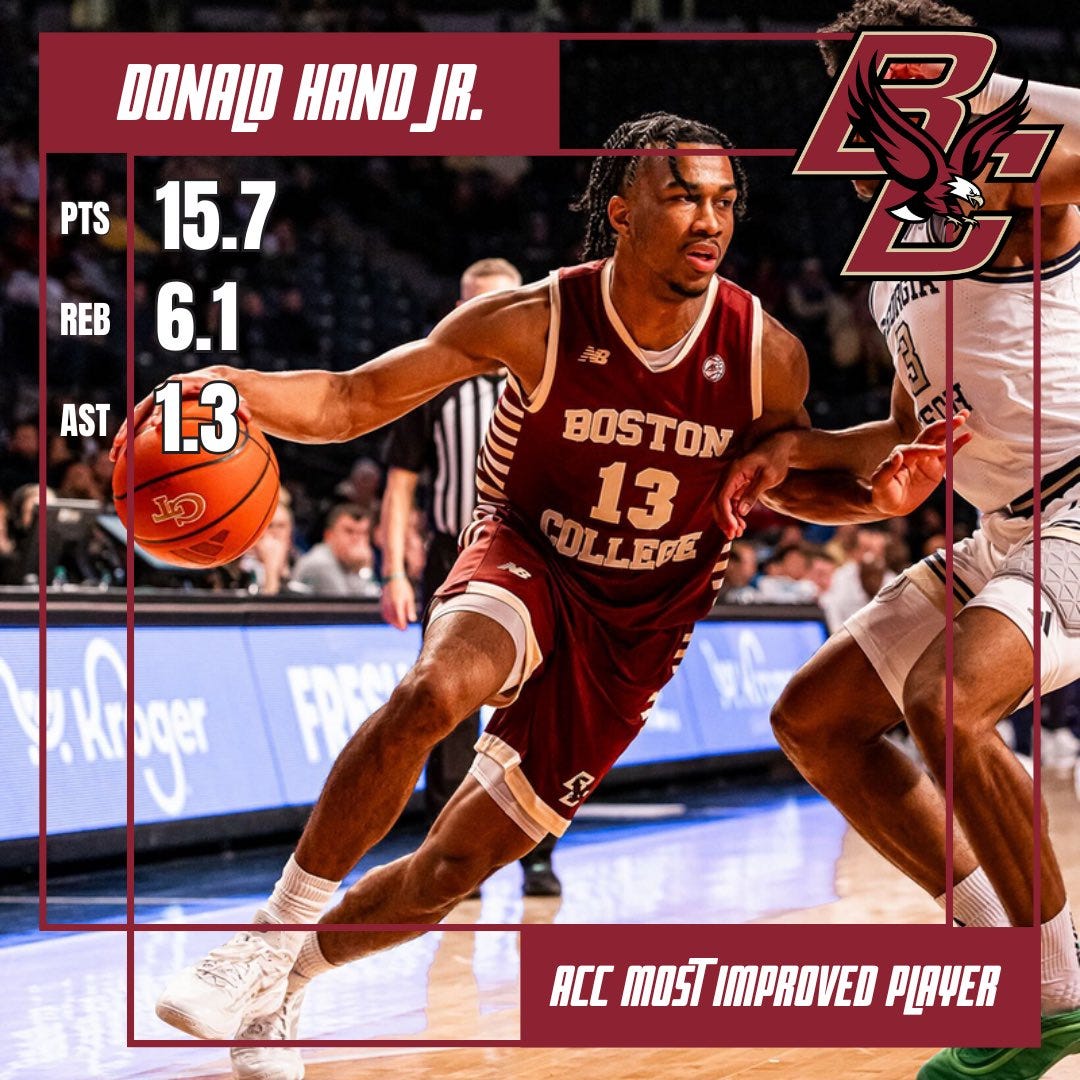
Donald Hand Jr. (#13, Boston College): Junior, 6'5"
Shooting Guard — Date of Birth: Non-Public Information
Introduction
As the ACC Most Improved Player, Hand, Jr. was one of the bright spots in a year to forget for Boston College. After logging over 1,000 minutes played as a sophomore, he decided to return to the program for his junior campaign. A quick first glampse on his numbers indicate a high-usage and inefficient player. However, context is essential in draft evaluations, as Hand, Jr. has shown many flashes of playing in an NBA role surrounding positional and role versatility.
As a 2022 McDonald’s All-American Game nominee and one of the Virginia’s top high school players, Hand, Jr. entered the ACC with lofty expectations. However, after redshirting his freshman season, he grew into his role in the next two seasons. It’s expected that Hand Jr. will be Boston College’s leading player this upcoming season, which puts him on many NBA radars considering the opportunity to play team-leading minutes in a power-four conference. This scouting report emphasizes his NBA role and potential.
Physical Profile
At 6-foot-5, Hand Jr. has good positional size to play as a two and spend time in both guard positions. At 210 pounds, he filled his frame in the last few years, giving him a strong upper body and broad shoulders. He has a strong core and shows good footwork, which helps him balance his body out as a scorer, but also in defensive situations.
Hand Jr. is a good athlete. He has good foot speed and decent lateral quickness. He’s tough and physical and relies on his strength rather than using speed as his weapon. That makes adjustment to the NBA more feasible, as he can continue to grow into his body. Hand Jr. has decent verticality and good length. There is no official measurement available, but his wingspan should measure out at plus-three or plus-four inches.
Offense
Passing, ball-moving, and playmaking
At 39 assists to 44 turnovers as a sophomore, Hand. Jr does not convince as a passer number-wise, but the context here is essential. Boston College is asking him to carry the majority of the scoring load, with less possessions where he’s utilized as the passer for others. Regardless, ball-moving and executing reads are two strong areas of his game. Therefore, it’s feasible that the playmaking reps will increase in his junior season.
Considering the strength and good lateral speed, Hand, Jr. is best to create advantages with his dribble penetration. With his positional size and reduced ball touches, he’ll likely will rely on closeouts to create advantages in the NBA. The first play is an example. After getting two feet inside the paint, Hand, Jr. keeps his composure and finds the right passing angle for the kickout pass to the above-the-break shooter. NBA scouts often seek composure and angle creation to determine how much passing will translate. The second possession shows another strong example. Hand, Jr. has his assignment close to him and sees help defense rotate after his dribble penetration. Hereafter, he plants his jumpstop and immediately moves his body at 270 degrees to create the angle to immediately pass after planting his feet.
With the NBA game relying on pace and ball movement, Hand, Jr. has to make quick decisions. That’s where he flourishes in the open floor. The third and fourth plays show him leveraging his scoring prowess in the ‘grab-and-go’ instead of passing the ball ahead. He’s luring defenders in before finding the scorers with a launching pad to the basket. With consistency in his decision-making, it’s feasible that his passing and ball-moving will improve and translate at the next level.
Catch-and-shoot
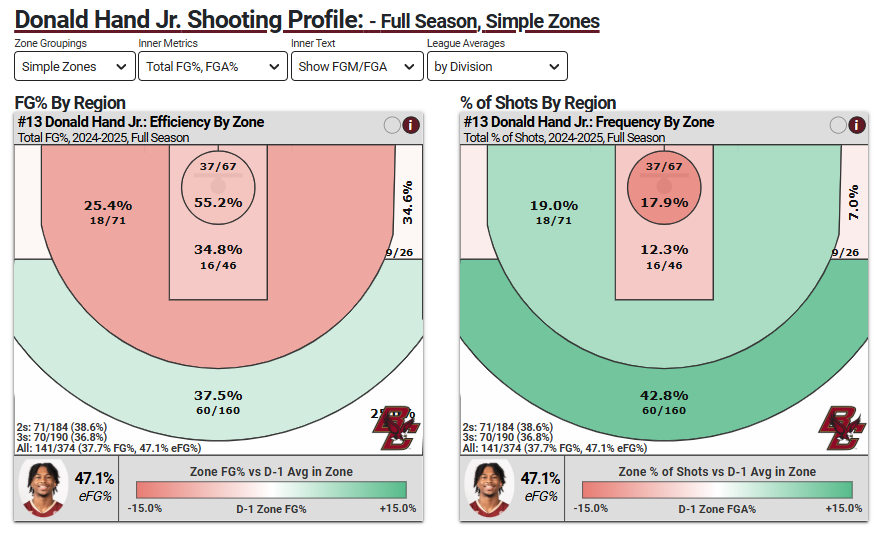
At 36.8% on over six attempts per game, Hand, Jr. shows healthy returns on his three-point shooting. For NBA teams the off the dribble or one-dribble shots are essential. That’s because you don’t want to focus on solely catch-and-shoot options, as self-creation is vital in the playoffs. Regardless, Hand, Jr. shows a strong one-dribble where his footwork speaks volumes. He’s excellent at pivoting and turning his body to immediately get to 180 degrees before rising for his shot. The first play below shows an example.
That’s the type of threes which NBA scouts prefer. Shooting over 40% as a one-dimensional catch-and-shoot option makes it very context-reliant to determine if that translates. But in Hand, Jr.’s case, his focus on pivoting and preparing his body while keeping the ball decently high before rising up determines a steady and feasible shooting form to grow into a volume shooter in the NBA. The second and third plays below show two good examples of how well that’s leverage for his true skill as a interior scorer and slasher.
Self-creation out of handoffs
This leads to Hand, Jr. being a primary candidate to be used in handoff sets as well. He’s good at making quick decisions. However, that’s often not the good one as he settles for too many jumpers. The first two plays below show examples. He has the strength to draw help defense to either attack the rim or make the extra pass. A player with his dribble penetration shouldn’t settle for shots, as his strength is seen when he’s forcing his way downhill. The third possession shows a combination of crisp footwork and physicality, creating a clean angle to score.
The primary objective in handoffs is to force a switch and break the defense down. During his sophomore season, there wasn’t enough passing out of his advantage creation. That’s an essential part to improve in his junior season. The fourth play below summarizes everything. When struggling to get downhill, there was not enough court vision shown to make or seek the extra pass. That led to inefficient scoring numbers, despite these being fixable when Hand, Jr. settles for fewer forced shots.
Closeout scoring
When creating plays out of closeouts we see Hand, Jr. prioritize the midrange. That’s a good habit, as it opens room to make the extra pass or cash in from his created space from a closer range to the basket. Hand, Jr. doesn’t consistently take the most of every possession. He’s often picking up his dribble against pressure, where he’s trying to create by using his footwork and strength in the form of face-up scoring. The first play shows an example.
On top of that, he doesn’t have to attack the closeout every time. The second possession shows a midrange shot, while there was enough room to take the corner three. In terms of sustaining a team’s offensive rating, that’s an area of attention for NBA coaches to help him with Optimizing shot selection is one of the things Hand, Jr. must work on. Regardless, Hand, Jr. is a gifted space creator with his footwork. With a great last step, he’s often stretching his pivot or reverse pivot to keep in passing or shooting motion. This leds to him utilizing his length while showing good verticality on his midrange jumper. The third and fourth possessions show examples.
Subscribe Now!
Defense
Pick-and-roll
There are a few areas of development defensively, with screen navigation being the primary one. Hand, Jr. often dies on screen and he’s late to recognize switches, making it easier for opponents to collapse the defense. However, playing on a bad team, the effect snowballed while it wasn’t solely on him that Boston College struggled defensively. Another part of his game is that he’s too reactive to what scorers try against him. That leads to him being shaken out of balance. The first play shows an example. With his strength, it’s easier for Hand, Jr. to take ‘beat me’ approach and play more with drop, anticipating on the incoming ball screen rather than fully focusing on the ball handler.
However, the effort is never the issue. The second possession shows an example. Fighting through the double stagger, Hand, Jr. does well to keep track on the ball handler, where naturally the rotations should have put less pressure on him. Regardless, NBA teams won’t run double staggers for shooting specialists that often. The basics of screen navigation are the essential area of development for Hand, Jr. to grow into an average defender on that end. The third possession shows a good example. With an effective drop, Hand, Jr. dodged the ball screen while showing great vertical pop on his shot contest. In the fourth play, Hand, Jr. sees the incoming screen, not fighting through it while focusing on keeping the tag on the ball handler.
Closeouts
As mentioned earlier, Hand, Jr. is too reactive in his defense. That led to scorers often deceiving him, knowing they cannot beat him physically. Therefore, the advantages of the physical tools won’t show on the floor with his defense yet. The second play shows an example where Hand, Jr. is shaken out of balance, opening the baseline for the dribble penetration and dunk at the rim. However, there’s a lot of potential to grow into a positive closeout defender. Hand, Jr. has a great and quick second jump. The first play shows an example, where he’s caught in the air, but immediately bounces back to react to the sidestep.
It’s easy to remain negative about the reactiveness. However, there’s too much potential physically for Hand, Jr. to grow into a niche with his closeouts due to the combination of lateral quickness and verticality. Add the quick second jump, and he has more compensating factors when biting on getting deceived. However, the NBA game is all about fast decisions and efficiency. Therefore, NBA teams won’t be comfortable to give him reps while seeing their defensive rating plummit. Reactiveness is the big enemy here. The third play shows him biting on the gather, while he’s opening the angle for the duck-in in the fourth possession. Hand, Jr. needs to be more proactive and demanding in his junior season. That’s a big part of his defensive profile.
Cuts and movement away from the ball
Ball-watching is another area of attention. As mentioned earlier, Hand, Jr. has too much focus on the ball handler. In a motion-based NBA game with ball movement that’s a silent killer for a team’s defensive rating. Therefore, it’s not feasible that Hand, Jr. will play NBA minutes based on his sophomore year, makes it a heavy part of his evaluation for his junior year. In the first play a bad habit is put on display. After the post-entry pass, Hand, Jr. looks to walk, not keeping a tag alive on his assignment or keeping control to react to motion. That’s leading to a backdoor cut in the second play below. Ball-watching is prone for getting backdoored. Improving his feel for the game against motion offenses is where NBA teams need to work on when taking him in.
Catch-and-shoot
For Hand, Jr the best way to improve his rotations and reaction time to motion is to focus on catch-and-shoot options. Those are the easiest to improve in live reps because he’s not dealing with ball screens or screens away from the ball that much. When he has unclouded vision on his assignment, he’s much faster to respond and adjust. The first play shows an example against the above-the-break shooter. However, realistically, in the NBA that’s not feasible. He’ll always deal with screens away from the ball. This leads to his screen navigation needing to be good enough to compensate for some late rotations. The second possession shows an example.
However, one of the positives is Hand, Jr.’s speed and length. That gives him something to fall back on when he’s allowing too much space to shooters. The third possession shows him giving up angles when shaken out of balance, while he’s closing out too late in the fourth play. As of now, Hand, Jr. is far from NBA ready to play minutes. Regardless, there’s serious potential to grow into a role player with positives to offer on defense, as ball-watching and reactiveness are the two essentials to focus on in his junior year.
NBA Draft Projection
Based on the strengths and areas of development mentioned in this scouting report, I project Donald Hand, Jr. to be a draftable player in the 2026 NBA Draft. His blend of physical tools, size, slashing, and volume shooting matches the offensive need many NBA teams have. But the other side of the coin is that he’s defensively not ready to play at the next level. Regardless, his junior year will put him on many NBA radars, with a clear path to be an All-ACC player as Boston College’s main option. Looking at the NIL space, it’s more feasible that Hand, Jr. will use his four years of eligibility, giving him the chance to be one of the most-wanted seniors in the portal next summer. NBA teams must keep him on their watchlist and continue to gather intel.