
De'Shayne Montgomery Scouting Report
While two-way guards are scarce, the Dayton-standout might fit in that mold after showcasing his entire package this season. Here's why I believe he'll get his name called on draft night:

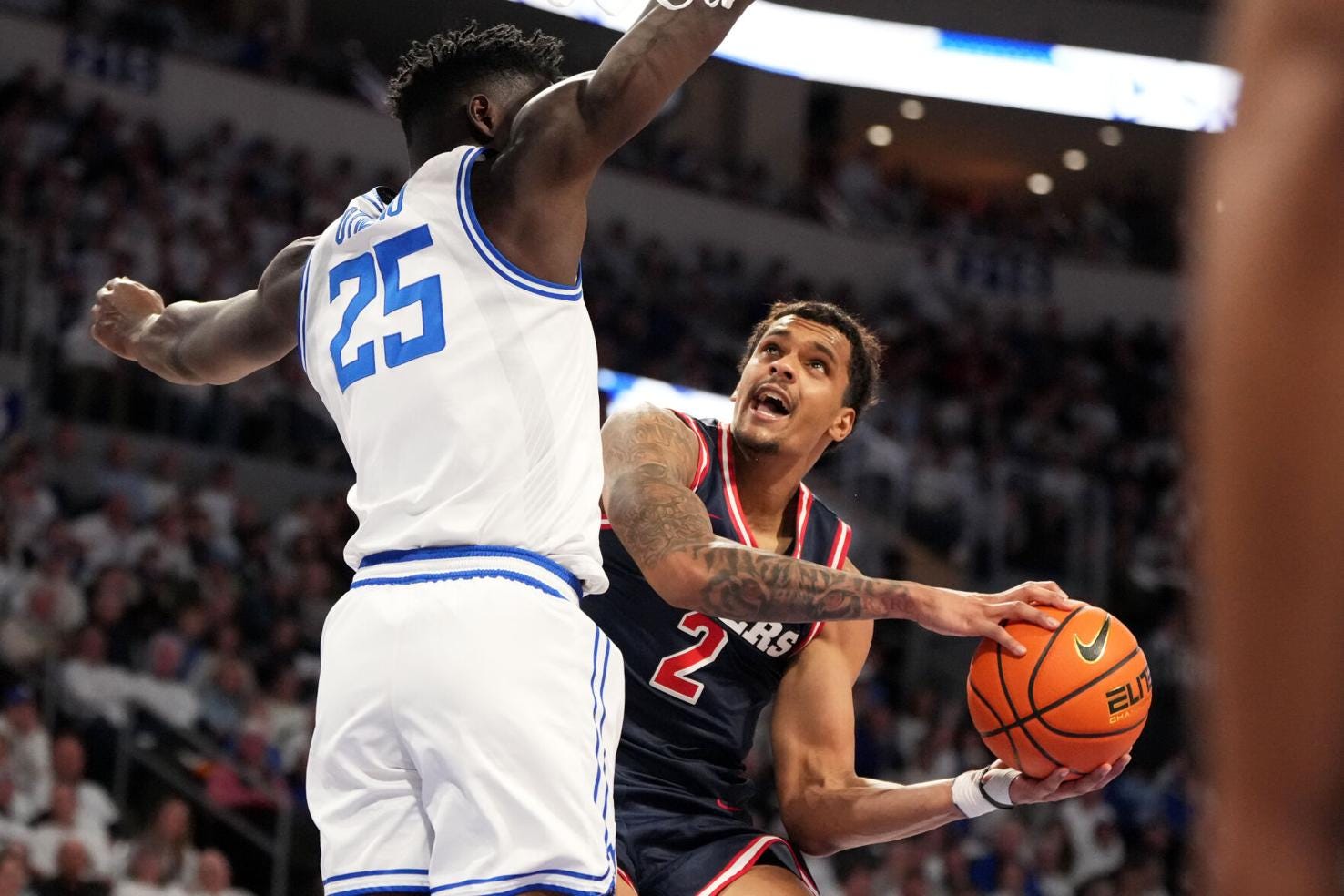
De’Shayne Montgomery (#2, Dayton): Junior, 6’4”
Shooting Guard — Born: Unknown
Introduction
After winning MAAC Rookie of the Year, the ultra-efficient 13-points-per-game scorer Montgomery decided to move to the SEC and commtited to Georgia. That’s where things went south for Montgomery as he didn’t get the opportunity to play that he first anticipated. Hereafter, he hit the transfer portal again, and committed to Coach Grant and the Dayton Flyers while moving to one of the most competitive A-10 leagues this decade has seen.
He’s at over fifteen points per game, while showing great efficiency and shooting prowess on top of the defensive nature of his game. The term two-way is thrown too loosely nowadays. But Montgomery’s defensive game with clear flashes of fitting into NBA offenses like a glove makes him a legitimate prospect. The emphasis of this scouting report is to showcase a feasible role to grow into while also focusing on his long-term potential.
Physical Profile
At 6-foot-4, Montgomery has good size to be a full-time two in the NBA. He’s a good athlete with broad shoulders while continuing to fill his frame. Great hips. Fluid with good footwork. Good core strength. He’s a vertical athlete with great length. There’s no listing available, but I think he’ll measure out with a +5 or +6-inch wingspan.
Overall, Montgomery must still grow into his body. He’s listed at 190 pounds, while he can still add to his frame and bulk up to 200-205 pounds. Getting stronger should be the main focus for the next few years.
At over 300 (!) articles in 3.5 years, Ersin’s NBA Draft Newsletter is your go-to for draft content. Make sure you subscribe at $6 per month for much more!
Defense
Pick-and-roll
Montgomery slides his feet very well while showing a good last step. He’s a good screen navigator, but looks passive when he’s forced to play physical against scorers using ball screens to get separation. The first play has him dodge the screen well with a quick pivot to create a cushion to dive between both ball handler and screener. He’s keeping up with his assignment well, showing a good contest despite the made shot. However, he’s not playing hard enough when ball handlers throw him in screen actions.
The second play shows an example of him doing all the things right, but the lack of toughness not being in Montgomery’s favor. At 2.1 personal fouls in over 30 minutes per game, he’s playing in control but could afford to gamble a bit more in games where he can play more physical. Regardless, there’s potential for him to defend in volume against ball screens. The third play has Montgomery close the angle, forcing the scorer to make another decision while using his length to contest the elbow three well. Regardless, the main area of development is to play with a lot more toughness. The fourth and fifth plays show examples.
Closeouts
Montgomery has to put work in to improve his closeouts. Two things stand out being the reactiveness and closing out way too far. The vital part of closing out in the NBA, is that once you’re putting your feet outside the interior, most scorers will gladly take that opportunity to drive downhill and collapse the defense. More teams play four, or even five-out, so taking away the shot is the main emphasis as most teams try to maximize their threes. This makes it much easier for defenders to ensure they can impact the shot with their length and keeping scorers out of the interior.
The first play shows Montgomery committing too far and immediately getting his rim pressured. We see a similar outcome in the second play, where Montgomery’s shaken out of balance because he’s so reactive. He’s great at playing the angles in the pick-and-roll, and has to continue doing so in closeouts. Because the length and good verticality help Montgomery to contest while he can still afford to give scorers a tad more space than he has in mind. However, he must always close out at 180 degrees. The third play has him give up the baseline, immediately seeing that and taking the reach-in foul to stop the easy two at the basket.
The reactiveness is leading to another area of concern, being his defensive rebounding. The last play below shows an example. He’s busy watching the ball instead of being in box-out mode. At a defensive rebounding rate of less than 11%, that’s not a feasible number for him. With the NBA continuing to grow in size, rebounding is the main area where Montgomery must stand out, but that’s where he’s consistent enough, despite averaging close to five rebounds per game in three straight seasons now.
Cuts and defending away from the ball
Montgomery’s quick hands and good instincts has led to him averaging 2.7 steals per game, while putting up an impressive 2.7% block rate as well. When he’s playing tough and locked in as an off-ball defender, we see him use that to make winning plays on defense. However, often we see the game going a tad too fast for Montgomery. He’s processing the game well, but a tad too slow. The first play shows an example where Montgomery is the help-side defender on his team hedging, where the help defense arrived too late and therefore was too easy for the roller to make the dropoff pass.
The second possession has Montgomery make a much better rotation after the double paint touch. Purely on instincts. That’s the impressive part in his profile and making it feasible that he can be an above-average steal-producer. Regardless, the reactiveness is an habit that’s getting in his way more often than not. The third play shows an example. Montgomery has nothing to gain by following with the motion that lured him to step on the three-point line whereafter he got hard-cutted to the rim. Being less reactive is going to change everything in his defense, as most occassions with mistakes, reactiveness and lack of toughness stand out. On top of that, the ball-watching is an area of focus as well, with the last possession below showing an example.
Subscribe Now!
Offense
Shooting off the catch
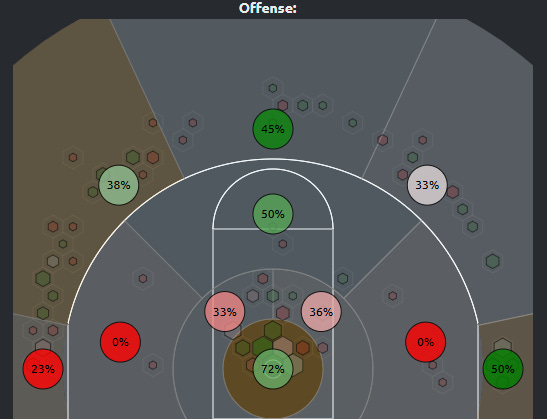
At 37.4% on over 2.5 attempts per game for his college career, Montgomery is giving more than solid returns. It’s not all about how he’s doing recently. The bonus part with prospects having a bad year, is that it helps to locate consistent factors much more effectively. And that’s what his shooting has been. The chart above shows him preferring corners and above-the-break threes. He’s incredibly active motion wise on offense. The first three plays below show him get to his spots in the corner, with the common denominator being that he’s barely jumping in the air on his shots. The hustle play in the second one is a positive as well.
That’s positive in terms of durability. He’s not putting much pressure on his knees and ankles. He’s completely balanced and shows a high-arcing release. The best part is that Montgomery’s a one-dribble shooter, but that’s not how he’s utilized at Dayton, where, when not playing on-ball, he’s playing more in a stationary-shooting-heavy role spreading the floor out and getting to his spots with his cutting. The pivot foot is good value and he’s keeping the closeout-attack alive. The fourth play shows an example. Overall, Montgomery will be an average shooter at worst in the NBA, where increasing his volume will be the main challenge.
Self-creation out of pick-and-roll
The self-creation is the bonus teams get with Montgomery. Decent handles, not great but good enough to where his change of pace is changing everything for him. That’s where he has such a tremendous feel for the game. Has some tunnel vision as a scorer, but he’s drawing contact with ease. He’s also crafty. The first play shows him playing the angles and playing with his pace to find the open finishing angle underneath the basket. At 65.8% at the rim without dunks, his great touch is showing why it’s so feasible to translate to the NBA.
The second possession has him playing with his pace to draw in multiple defenders. He got to the charity stripe, where he’s finishing at over 84% on three attempts per game. But the tunnel vision is getting in his way. With doubles or help arriving, Montgomery’s first instinct has to be to kick the ball out to the open shooter and force rotations to the already collapsed interior defense. At less than three assists per game while seeing a fair share of on-ball creation opportunities, that’s not a good look for Montgomery. The second play shows him miss the corner shooter on the weak side.
Regardless, he’s crafty and finishes with both hands around the basket. The fourth play has him going from east to west while leveraging the contact to get two feet deep in the paint. He’s a born scorer that has grown into a volume shooter as well. Scaling his role up and down in a feasible way is the main gain NBA teams get in his profile. On the other hand, the tunnel vision as a playmaker is somewhat worrying, but less important because he’ll likely scale his role down in the NBA compared to the 22.7% usage he’s enjoying at Dayton
Slashing and making plays out of closeouts
The lack of readiness to play NBA ball is getting more clear in how Montgomery makes plays out of closeouts. He’s much more demanding in ball screens than when he has to attack a closeout. The first play shows an example of how the lack of true toughness and top handle is getting in his way as he fumbles upon diving into the defender’s chest. That’s connected to the need to get stronger, as mentioned above, as he’s not handling the contact well. We see a similar outing in the second play, where Montgomery is driving into a crowd and the tunnel vision kicks in, getting blocked and hitting the deck once again.
Overall, focusing on his mistakes, the handle is the main issue. He’s at a 14% turnover rate compared to 20% in his first two college seasons. That’s not a good number, and it shows how things change for Montgomery with the easy turnover in the fourth play below. Regardless, despite the miss, the fifth play shows why I believe Montgomery will get better. He’s so good at these east-to-west sequences, changing sides easily while playing with his pace. The two-handed finishing at the rim is the main value. But handling contact is still in need of work. When that happens, Montgomery’s closeout scoring will be much better as he’s already mastering how to play the angle in tight pockets.
NBA Draft Projection
Based on the areas of improvement and strengths mentioned above, I project De’Shayne Montgomery to be a second-rounder in the 2027 NBA Draft. However, he must test the 2026 NBA Draft waters this summer as a junior, where the scalable role to a closeout attacker and great stationary shooter from the main initiator will serve him well. He’s best to play as a two, but with the bonus that he’s gifted with great change of pace and craft as a pick-and-roll scorer.
Defensively, the room to be way above average is wide-open for him. However, the reactiveness and lack of toughness are appealing. That’s a red flag for NBA scouts, as toughness is everything, especially when entering the league knowing teams prefer prospects at or over 6-foot-6 instead of the 6’4” Montgomery is. Regardless, the instincts and footwork make it feasible that he can adjust to a faster NBA game.
Overall, with a year of eligibility left, it’s best for Montgomery to return to Dayton and improve via a quality role and lots of live-game reps. The tunnel vision as a scorer needs to vanish, and if that happens we’ll see a possible rotational player for the NBA. In today’s NIL space no one has to rush their way to the league anymore, and that’s making it easier for upperclassmen to take a traditional four-year path. I would recommend the same for Montgomery.
At over 300 (!) articles in 3.5 years, Ersin’s NBA Draft Newsletter is your go-to for draft content. Make sure you subscribe at $6 per month for much more!
Also Check Out
Articles
All of my other 2026 NBA Draft related in-depth scouting reports
JUCO Basketball: in-depth analysis on prospects you never heard of