
Darius Acuff Jr Scouting Report
Detroit toughness combined with consistent shot-creation gives Acuff, Jr. a potentially high floor. He's a first-rounder with a clear path to start in the NBA. Here's all you must know about him:
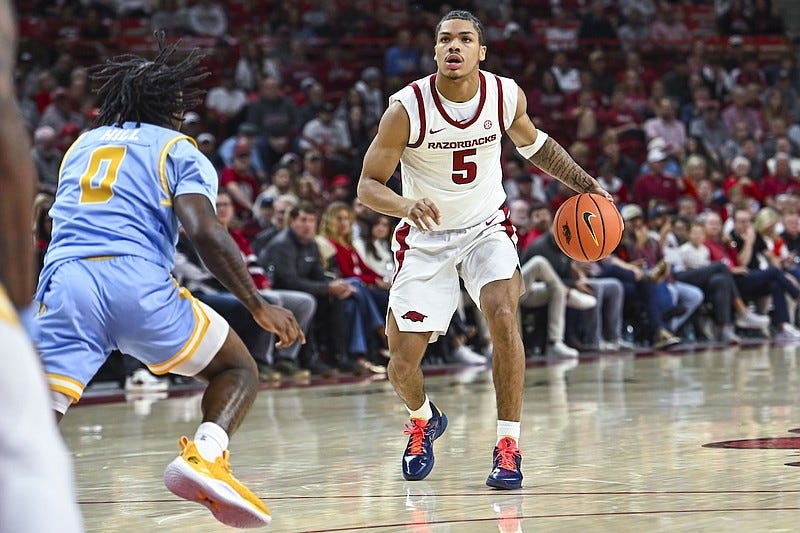
Darius Acuff Jr. (#5, Arkansas): Freshman, 6’3”
Point Guard — Born: Nov 16, 2006 (19 years old)
Introduction
As a consensus top ten recruit nationally, Acuff, Jr. committed to Coach Calipari and his staff, where he has had a strong start to the season. While scoring an efficient seventeen-plus points per game, he’s showing why Arkansas is his team to run. That’s a positive for NBA scouts, as we don’t often see freshmen in that type of situation while playing for contending teams.
He’s been given the standard ‘too small’ label which is simply bad prejudice. Especially considering how much strength and finesse define his game on top of a high natural feel for the game and an explosion of creativity as a scorer and signal-caller, as we often see among guards from the Detroit, MI area. This scouting report emphasizes his NBA role and long-term potential while showing the areas of development to focus on at the next level.
Physical Profile
At 6-foot-3, Acuff, Jr. might be on the smaller side, but his physical development more than makes up for it. He has a strong frame and good upper body strength. With broad shoulders and natural Detroit-styled toughness, Acuff. Jr. doesn’t shy away from playing physical. He has a great core and balances his body well. His crisp footwork on the offensive end in how he’s plants his last step and uses a change of pace to create angles.
Acuff, Jr. doesn’t have elite explosiveness or a top first step, but shows good lateral quickness. On top of his length, he shows good verticality, which helps him around the rim. He’s officially measured with a 4.5+ inch wingspan at the 2023 Nike Elite 100 camp. The length adds to his will to play physical. At 190 pounds, Acuff, Jr. can continue to bulk up to compensate for the lack of size, as his game is not built on exploiting explosivness or speed, but good decision-making and toughness. That’s the positive about his physical tools and how much teams can continue to tap into the potential.
Defense
Pick-and-roll
Acuff, Jr. has a surprisingly mature game on the defensive end. We don’t see teenagers often with his level of footwork. The last step is the area that caught my attention. In the pick-and-roll he’s good at navigating through screens, using his quick feet to his advantage, while widening his arms actively to tag early and win himself a bit more time to throw himself between screener and ball handler. The first play shows an example. He slightly slipped on the last step, but the length and verticality led to his advantage in contesting the jumper off the dribble with confidence.
The second possession shows him again using his wingspan to his advantage. Felt the incoming ball screen and threw himself between both opponents. His last step was good as he managed to keep his balance and use his verticality. However, professional scorers in the NBA would use that gather to blow by him, as his opponent settled for the jumper instead. Therefore, keep working on improving his already good last step should be his priority. Acuff, Jr. makes the good decision to ICE the ball handler going toward the baseline in the third play. The decision-making in the pick-and-roll should give teams more confidence to counter the classic argument that he’ll be targeted by opposing teams.
He’s also tough when the ball handler gets downhill. Uses physicality to keep opponents at arm length, slightly pushing the scorer off after the paint touch. That led to the opponent losing its balance. The lateral speed is good and the footwork impresses me as Acuff, Jr. uses both his physicality and speed to stay in front of ball handlers. It’s very much feasible we’ll see Acuff, Jr. have a neutral impact at worst on a team’s defensive rating once he’s settled to the NBA’s game and pace.
Closeouts
Acuff, Jr. shows good speed in his closeouts. However, we’re still seeing freshman mistakes in his game; specifically his habit of closing out too far. That’s making it difficult for himself, as he must focus on speed to compensate for the mistake, and that’s where his game is not the strongest. The first play shows him get to the elbow fast, but he’s closing out too far and the ball handler simply exploits his late last step. Regardless, a positive is that he’s again using tags to force the defender to go wide, whereafter he contested well on the midrange jumper. The second possession shows Acuff, Jr. closing out fast again, but he’s giving away the baseline in not staying at 180 degrees of his opponent. That’s how he’s bailing scorers out, as they have a choice on where to attack him, instead of forcing ball handlers to make a decision instead.
The lack of composure is the biggest area of development. The fourth play shows him again immediately jumping after the closeout. That makes it very easy for scorers to simply fake and burn him off the dribble. Therefore, trusting his length and verticality and keeping a hedging distance to take away the dribble penetration while being in range to contest jumpers is the main area. That’s the game closeout defenders continiously play. Despite the blocked shot at the end, that’s a bad defensive set as the defense collapsed prior. The toughness is never the issue, as the motor is impressive and consistant. The third play below shows an example.
Handoffs
Seeing Acuff, Jr. thriving in navigating through ball screens, we’ll likely see him defending in handoff sets as well. That’s how many NBA teams operate, using the five as a hub at the perimeter, mostly screening and handing off to create separation for their ball handlers. Considering the average size, we must put more importance to playing and defending screens heavier into consideration. The first play leads to a personal foul after Acuff, Jr. gave up separation while failing to get between screener and ball handler. However, he’s using his arm well to create the cushion to not fully launch into the wall.
The second play is perfect from start to finish. Shifting and sliding his feet, moving toward a 135 degree line to close angles and driving lanes. However, he bites on the pump-fake and the crafty scorer almost gets the and-one. There’s serious defensive potential in Acuff’s profile, but the lack of composure and decision-making is mostly age-related. More reps will polish these freshman mistakes as it shouldn’t count as a real red flag in his evaluation. The value increases when seeing the effort, motor and natural toughness that Acuff, Jr. consistently has shown so far in the season.
Transition and positioning in the open floor
To complete the defensive evaluation, we must take the NBA’s pace and speed into account as well. That’s why transition defense makes the most sense. The trickle down effect of teams wanting to maximize it threes is that we see more long rebounds where teams try to improve their offensive rating by improving the margins with more points in the open floor. Acuff, Jr. has shown a lack of positioning due to bad composure, especially in closeout, which makes closing angles and positioning while running back on defense one of the question marks in his profile.
The second possession gets called with the foul. At under two fouls per game while playing over 75% of the minutes, Acuff, Jr. shows he’s in control. The toughness prevails and I like how he positioned himself to force the scorer to finish over him. That’s the feasibility test for him to improve as you saw he’s busy closing angles. The third play shows a similar outcome. That’s the most vital part as transition defense is heavily context-related, while the idea in the evaluation how fast he’ll get back on basket while not giving up baskets too easily.
Subscribe Now!
Offense
Pick-and-roll scoring
Creativity and poise summarize Acuff, Jr.’s on-ball game. He’s beyond his years in how he’s matured in recognizing and playing the angle while using his change of pace and tight handles to create the advantages he seeks. However, naturally he’s still going through freshman mistakes such as forcing tougher jumpers when he can’t find the angles and advantages he seeks. Regardless, there’s clear potential in game where NBA scouts will trust him in a ball-dominant role at the next level.
The first play shows Acuff, Jr. using his change of pace before he pops to the rim. That’s the main weapon. The handles and creativity in playing with speed is similar to how less-athletic top guards in the NBA keep surprising the defense. Despite hitting the deck, Acuff, Jr. did well balancing his body before colliding with the two big bodies underneath the basket. The separation off the dribble is the main indicator of guard success in increasing ball touches.
The ease with which he finds space is shown in the second possession, showing a healthy release on his three off the dribble. However, he’s too optimistic in finding the angles with his craft. The pressure in the third possession should have led to him keeping his composure and passing out of two opponents coming at him, instead of forcing his way to use his craft to get free. Regardless, the toughness is a big part of how Acuff, Jr. finds his spots. The fourth play shows him hide the ball with his right before putting his head down and attack the defender’s chest for the separation before the well-placed tear-drop. The touch inside the paint and around the rim remains one of the better indicators of his scoring potential.
Creativity out of closeouts
Acuff, Jr. is a born playmaker. He’s making reads to focus on using his advantages and collapsing second defenders on him to find the open teammate. However, he has to be more consistent on that end when he’s operating as a slasher while making plays out of closeouts. The first play shows an example. Great dribble penetration where he’s creating the angle to make the side pass to the cutter in the middle, but opts to finish through two opponents. Despite the clear advantage creation, he has to polish and round out his game to eliminate bad shot attempts like that, and focus on making the extra pass. That’s especially vital when considering how easily he has help defenders on their toes, ready to collapse on him early.
The second possession shows Acuff, Jr. recognizing the driving lane in the middle, rejecting the first handoff before switching sides. He maps the floor very well, and he’s seeking to use his floater when he sees rim-deterrants underneath the basket. Especially for smaller guards, the floater is a must-have in their offensive scoring arsenal. At 3.3 free-throws per game, that’s a number we must see increase throughout the year, considering how easily he draws contact. That’s feasible to happen. The third play shows him immediately seeking contact off the dribble whereafter he’s entering his finishing mode. With more space in the NBA, that’s a skill that’ll serve him well. At 65.6% rim-finishing, the touch around the basket shows good returns so far this year as well.
Passing, ball-moving, and playmaking
At 49 assists to 18 turnovers so far this year, the number confirm what we see on the floor: top-notch playmaking. As mentioned earlier in the report, Acuff, Jr. has matured his game already and is consistently executing his self-created reads. Considering his role as a point guard, the skill as a ball-mover are less relevant, as he’ll mostly conduct creating open shots and layups for others. His court mapping is great and he’s recognizing angles with ease. Considering the creative nature of his game with his change of pace and tight handles, he’ll keep help defenders on their toes and can immediately operate after he sees a second defender coming in. He’s not composed enough to consistently make the right decision, where he settles for jumpers a bit too much.
Regardless, he’s a pass-first operator where the first two plays show him making some easy execution passes, first in transition while he’s also immediately seeking to pass out of the offensive rebound. The third possession below shows the quick read out of the baseline out-of-bounds play. But that’s not the main value. His angle-recognition out of pick-and-roll actions is tremendous. The fourth play shows him change the pace, lure in the defense after the handoff pass and immediately hitting the cutter in the tight angle with a well-placed hard pass. The small habits are the difference makers. The last play shows Acuff, Jr. pivot as if he’s ready to penetrate inside the lane before switching to the side pass. It’s all about deceiving defenders by leveraging his threat to shoot and score.
Shooting off the catch
At 42.0% on 5.6 three-pointers per game, the numbers are sustainable for the foreseeing future. Acuff, Jr. has a good shot process where he sets his feet quickly and has a consisent process. The shot doesn’t have a high-arcing point which makes it a risk combined with the lack of size. But regardless, the release is decently quick and consistent. That’s a must considering the fair amount of stationary shooting duties he’ll have in the NBA playing alongside multiple ball handlers at the same time. The first play shows his NBA range on display, not bending his knees too far while showing a classic ‘L’ shape of his arm before the release. The balance on his jump is good, as Acuff, Jr. keeps him body at 180 degrees vertically.
The second play shows him pivot strong with his left, making his right foot more flexible in setting his feet on the side pass to the elbow. However, jumping makes him lose time before the release. The third possession sums up his strengths. He’s setting his feet immediately at the last step, and keeps the ball at the level of his chest. At 6-foot-3, every microsecond he can win in the process will benefit him a lot adjusting to the NBA’s speed. By keeping the ball high and not bending his knees too much he can rise up and release the ball much faster. The consistency is seen in the fourth play, with a similar outcome in terms of setting his feet, catch the ball and keep it high around his chest before rising up for the shot.
NBA Draft Projection
Based on the strengths and areas of development mentioned in the scouting report, I project Darius Acuff, Jr. to be a top 20 pick in the 2026 NBA Draft. The current NIL landscape gives the comfort to return to school and focus on improvement on shortcomings. However, that’s often not the best route for top talent who has seen the opportunity to play vital minutes for Coach Calipari. His physical readiness is the biggest reason why I believe he should focus on the NBA as a one-and-done prospect.
The NBA game is a specific context. His game is mature and advanced for a teenager which essentially should give him more to lose than to gain. The ‘NBA teams won’t draft undersized guards’ narrative is overblown and heavily context-reliant. The strengths in Acuff, Jr.’s profile, specifically the strength, change of pace and toughness make it feasible enough that he’ll grow and find ways to help sustain a team’s defensive rating. The offensive value is the main sell and he should be able to find spot minutes early in his career, as most NBA teams still struggle to find good depth among their point guards.
Also Check Out
Other Articles
All of my other 2026 NBA Draft related in-depth scouting reports
JUCO Basketball: in-depth analysis on prospects you never heard of
Podcast Appearances
2026 NBA Draft Talk with Corban Ford (Swish Theory/The Center Hub)
We spoke about the strength of this draft class, while discussing some other topics before doing a Mock Draft together! Make sure to subscribe to Corban’s podcast ‘Indie Basketball’. Here is the link!