
Coen Carr Scouting Report
As college basketball's best athlete, Carr is destined to find a role in the NBA despite being a non three-point shooter. Growing in Michigan State's system, he's set for a junior leap:
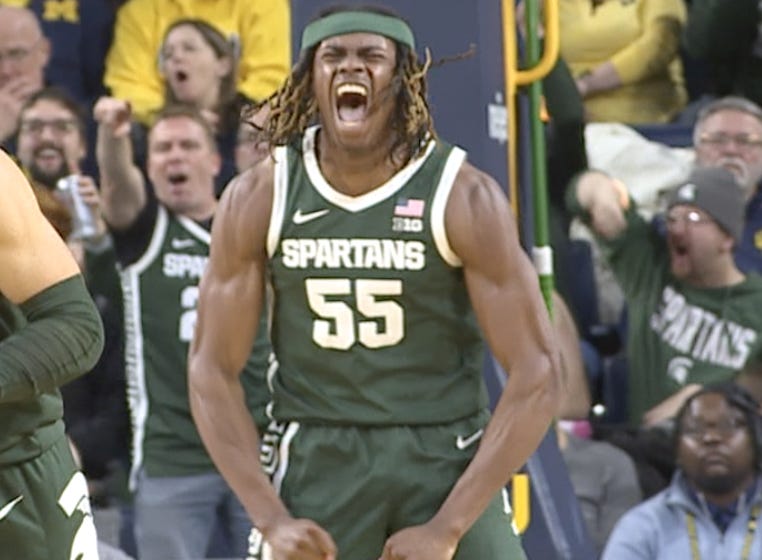
Coen Carr (#55, Michigan St.): Junior, 6'6"
Small Forward/Power Forward — Born: Oct 26, 2004 (20 years old)
Introduction
Coen Carr is the best athlete in college basketball. His long-term approach in Michigan State’s system is a good decision, as he grows into a feasible role while addressing the flaws of his game. However, as a junior he’ll continue to step up and takes the team’s leading role. This puts him much better on NBA radars, as there’s a prejudice on him as a non-shooting liability as a floor-spacer. But I’m betting on the contrary, as there’s serious two-way potential for him to grow into.
The term “two-way” is being thrown around too easily nowadays. However, the athletic tools and the role Carr fulfilled puts him in that exclusive conversation. The flash of his highlights often overwhelmes the substance. He’s a smart basketball player and this scouting report emphasizes a feasible NBA role and future for Carr.
Physical Profile
At 6-foot-6, Carr has the positional size to play as a three in the NBA. On top of his elite athleticism, Carr has a strong upper body and broad shoulders. He continues to grow into his frame and has close to elite core strength. He’s always in balance and plays a few inches bigger due to his verticality. That puts him in a position to play as an undersized forward in the NBA, as he can match up and cause problems against most traditional power and skill fours.
At 225 pounds, there’s the possibility to continue to bulk up and gain strength. In terms of his functional athleticism there’s an almost-clean blueprint available for NBA teams to maximize his physical potential. Carr’s quick feet, big hands, and elite verticality give them endless role versatility, with most of the value being on the defensive end of the floor.
Offense
Passing, ball-moving, and playmaking
At 20 assists to 32 turnovers, Carr is solely used as a ball-mover in Michigan State’s guard-heavy style of play. There are positive takeaways regardless that show he can play within a system while maintaining a higher pace and more motion. Executing quick reads is the base to evolve into a playmaker. Understandably, the Spartans wanted to bank off Carr’s athleticism as leverage by keeping him away from the ball. That versatility brings more value to his NBA role when Carr can show he can show the skill of executing basic playmaking reads on top of his ball-moving.
He’s a fast decision-maker with the first play as an example. He’s immediately bringing the ball up to get rid of the ball, seeking the post-entry pass before going to the corner. In the second possession he shows excellent hip flexibility by turning after the offensive rebound. Hereafter, he shows a similar court vision by kicking the ball out in the third possession. Carr gets rid of the ball quickly, but makes good passes, finding open teammates with ease.
He’s not passing the ball ahead in transition in the fourth play to where transition is his territorium. Regardless, he recognizes space and the driving lane before passing the ball near half court. For the NBA, Carr is best to be utilized as a ball-mover, with quick execution shown in the ball reversal in the last possession below.
Offensive rebounding and putbacks
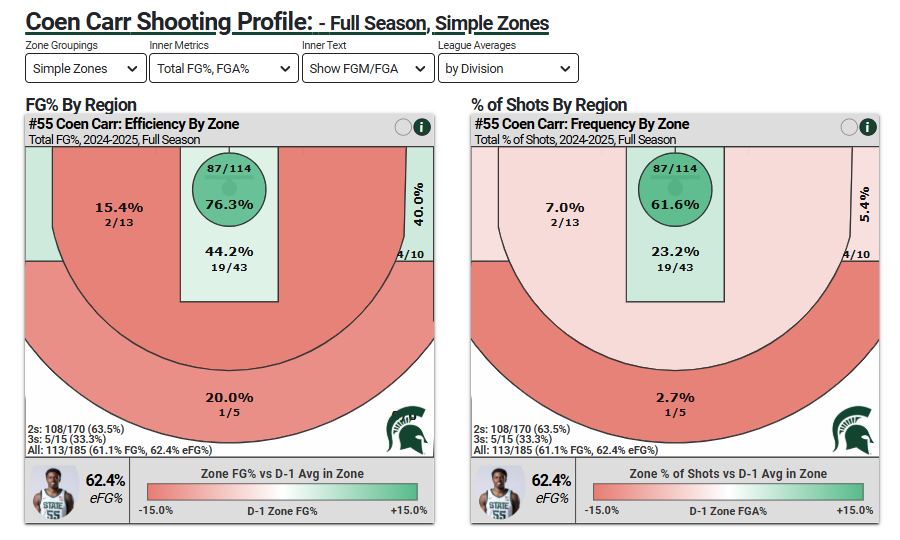
With 1.5 offensive rebounds per game while notching a 8.7% offensive rebounding rate, Carr found himself in the Big Ten’s top-15 in that category as a non-big. At 6-foot-6, he’s showing elite traits in creating second-chance opportunities. On top of that, he’s finishing 70.1% of his free-throws, which improved from his 56% during his freshman year. That gives him a weapon to improve his team’s margins in solidifying their offensive rating. That’s a must considering his status as a non three-point shooter.
His quick second jump is the base for his success, despite being undersized against fours and fives. The first play shows an example. Carr moves away from the defensive box-out, and smartly leaps to grab the offensive board. He keeps the ball decently high before rising back up with his second jump to finish the play. His fantastic leaping ability and toughness helps him to solidify his positioning as well. The second play shows an example where he’s finishing after his own missed lay-in attempt. The athletic traits combined with his upper body strength helps him to finish plays before landing on his feet as well.
The third play shows an example of him powering up against taller defenders. However, despite keeping the ball decently high, Carr could try and play a Gasol-esque game where he keeps the ball above his head after rebounds. Never bringing the ball down requires size, and for his game to translate to the NBA, it’s understandable that Carr prefers to bring the ball down to power back up. Considering his improving free-throw conversion, that’s a feasible way into hedging his chances. Regardless, NBA teams should monitor if adjusting his game is necessary.
Closeout scoring
Carr’s leverage as a closeout scorer will determine everything in the NBA. The lack of touch on his jumpers puts more weight into him getting paint touches. Therefore, teams were telling their assignments to keep dropping while not committing too much help defense in order to reduce chances to kickout passes. The lack of gravity as a shooter leads to Carr having to work twice as hard to get good angles to score around the basket. At 76.3%, as shown in the chart above, he’s bringing close-to-elite returns despite the aforementioned. Therefore, he’s already bringing many counters to the table, where most of them are scalable to the NBA.
He’s seen to aggressively attack defenders as he can overwhelm them with speed, but also with his strength and physicality. This helps Carr to still lure in help defenders and to execute his advantages. However, the lack of passing is worrying. He’s showing tunnel vision in his desire to score, often settling for jumpers which isn’t his natural scoring style. Therefore, he must focus on executing his advantages more as a passer, rather than playing solely as a ball-mover as mentioned earlier.
The first play shows how tough Carr is. He’s already slashing before the pass and immediately looks to force the defender underneath the basket to freeze. NBA teams look for counters, and in Carr’s case him switching from strength to speed and vice versa brings a new dynamic to him as a scoring option, especially with his returns around the basket. However, Carr is caught driving without a plan often. In the second play he must attack the baseline instead of going for the strong side and use the spin move. His space creation on drives is still in need for improvement. For NBA scouts the third possession is a vital one. Teams play drop coverage against him, and Carr struggles with that. He settled for a jumper instead of using his physicality to seek to collapse the defense and make the extra pass. Knowing he’s not a shooter, he’ll have to work on his decision-making on drives and utilize his passing options more. That’s a vital part of his development for his junior season.
Jumpers off the catch
Carr made five of his fifteen three-point attempts as a sophomore. The numbers are not relevant as it is all about potential and progress. Therefore, the focus should be how feasible it is that Carr will increase his volume in the next few years. In terms of evaluation, it should be treated like what Ryan Dunn was transitioning from when he left Virginia for the Phoenix Suns. In Carr’s case, the shooting potential is there, but his mechanics need work.
The first play shows a good example. The opponents are leaving the weak side entirely open, daring Carr to shoot. After the catch, he’s slow to set his feet and he doesn’t position his body at 180 degrees. Instead of bringing his arms into a ‘V’ position, Carr looks uncomfortable as he’s putting the ball too far ahead of him. That makes him rising up for the jumper look clunky, as he’s not balancing his body. Despite the made three, that’s not a feasible shooting process to ensure that he’ll be an average shooter soon.
The second area of attention is that Carr’s strong enough to keep the ball high. He should focus on not bringing the ball down at all and create a niche as a no-dip shooter. In the second possession we see Carr bringing the ball down before rising out of balance, hitting the side of the rim. In the third possession he’s also seen pushing the ball out of his hands, rather than showing a natural release. The positive part is that his feet are set decently, although it’s still too slow. There’s potential for Carr to increase his volume to a few attempts per game, but the outcomes should be less relevant as his jumper is not ready for the NBA, even if he’s shooting close to 40% this year.
Subscribe Now!
Defense
Pick-and-roll
Carr has the potential to grow into a great defender in the pick-and-roll. However, for that to happen he must improve his screen navigation and decision-making against jab steps and fakes. He’s too reactive in most occassions, which doesn’t stand out immediately because of how much the speed and quickness can disguise. Regardless, the sentiment is possible, as the level of toughness and physicality is a prevailing factor which helps Carr to fit into Michigan State’s defensive system.
The main area of focus should be the screen navigation. Carr is giving too much control to the screener by going around them instead of fighting through screens hard. The first two plays show examples. Carr is not comitting on the perimeter to the ball handler, and this makes the screener’s life much easier as they can pivot and relocate to cover the interior side. This puts more pressure on Carr as he’s leaving the ball handler uncovered while busy with the screen, putting the faith of stopping his opponents into the ball handler’s hands.
However, when he’s staying in front of ball handlers he can overwhelm them with his speed and physicality. The third play shows an example. Carr is closing the angles and this puts scorers in a tough position, as their creativity is the only thing that can save them. Therefore, Carr needs to pivot and already think about what ball handlers will do instead of being in constant reaction mode. That’s what kept him in the air, giving away the free finshing angle. The physical potential should be prevailing, as it’s clear that Carr will grow into a niche defender at the next level.
Closeouts
Carr gets lured out of the interior too much on his closeouts. He’s often caught in the heat of the moment, where his top speed and quickness aren’t putting him in a good position. He can close out hard and fast, but often, opponents lure Carr into closing out hard on them, so they can beat him while he’s out of balance. The defensive footwork is not good enough for the NBA. That’s because he’s moving too fast and doesn’t slide his feet with the same smoothness. Regardless, Carr should fix most of the issues with his positioning. His length and verticality are close to the 100th %ILE, and therefore he can afford to bet on giving perimeter ball handlers more space. Not a drop coverage style of play, but playing with the margins of the space he’s allowing to his opponents.
The first two plays show Carr stepping out of the interior. That’s where he lost both matchups. The importance of him sliding his feet and improve his footwork is essential to keep an NBA team’s defensive rating at par. This because NBA ball handlers and slashers seek these opportunities to break down defenses. Another area of struggle is closing out at 180 degrees. The issue with Carr is that he’s giving away driving lanes and has to go all-in on his last step and initial burst to stay in front of scorers. The fourth play shows an example. He can compensate, but these mistakes are not feasible for NBA teams to give him minutes early on in his career.
Post-ups
Carr’s role versatility mostly depends on his strength translating to the NBA. Therefore, post-ups are essential. He must show he can match the physicality when playing against bigger opponents, while he can show the foot speed when posted up against his own size or smaller guards. With more teams running playmaking through post-ups, that’s a vital yet underdiscussed way to evaluate prospects. The vital part here is that Carr is tough and plays physical, but often he’s simply not able to stop scorers when they finish over their shoulders. He struggels against hook finishes over both shoulders, as he’s facing opponents five to six inches taller than him. The first two plays show examples. Regardless, he can overwhelm and wear opposing fives out with his physicality.
NBA teams often go smaller to put more shooting potential on the floor. So basically trading defensive rating to get more offensive rating back. Carr playing as a forward or a smaller five is already the idea of hedging to generate more scoring and focusing on letting opposing forwards pick up fouls or wear them down. That’s Carr’s skill. He’s quick and shows good footwork when he can focus on the post-up option. His verticality led to the blocked shot in the fourth play. The positive is that he moves his hips fluidly when opponents throw creativity at him, with the spin move as an example.
NBA Draft Projection
Based on the above-mentioned strengths and areas of development, I project Coen Carr to be a solid second-round pick in the 2026 NBA Draft. However, I expect him to return to school for his senior year in East-Lansing because of the lack of a need to rush his path to the NBA. Growing around his non-shooting profile and working on consistency in his shooting process is a question that’ll always keep NBA teams busy when evaluating his profile. With today’s earning potential in NIL, prospects can afford to let the NBA wait for them instead of fearing they might fall out the year after.
Regardless, Carr’s athleticism gives teams an enticing toolbox to turn their team into everything they seek. Role versatility is key and prevails in this evaluation. Even if the shot doesn’t develop, there’s serious potential to add a stout defensive rating improver in Carr. His low maintanence and reduced ball touches are two essential parts that’ll fit what NBA teams are trying to put on their depth chart. Considering he’ll be a 21-year-old at the 2026 NBA Draft, the difference between entering the league a year later is zero to none. Regardless, recency bias is still a thing, even for NBA franchises. Therefore, I would expect Carr to go for it if he has a strong season with Michigan State.