
Bryson Tucker Scouting Report
The former McDonald's All-American kept his name in the 2026 NBA Draft. What's the intrigue? What will be his NBA role? Here's an in-depth scouting report on Tucker's future in the association:
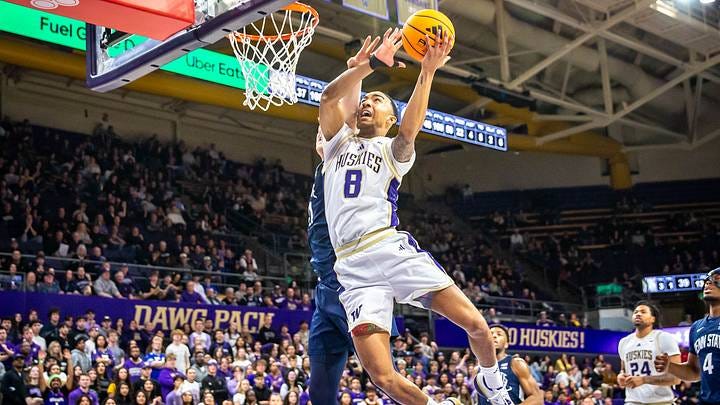
#8 Bryson Tucker, Washington: Sophomore, 6’7”
Small Forward — Born: Jul 5, 2006 (19 years old)
Introduction
At under six points per game in back-to-back seasons, the 2024 McDonald’s All-American decided to keep his name in the 2026 NBA Draft. A very interesting decision at first sight, but no one has all intel so I’m clearly valuing the high school production and Burger Boy outcome here.
Of course, college production isn’t everything either while it’s known NBA front offices also value high school film and production and take that heavily into account as well. Tucker’s always been a interesting wing prospect, but someone who had to overcome various injuries in the last two years.
Regardless, he has a chance to stick in the NBA. But for that to happen, he must grow into a feasible role while NBA franchises can still tap into his long-term potential. He’s still a teenager on draft night, and therefore must be treated as a long-term piece while still looking at the now-ready skillset. That’s the emphasis of this scouting report.
Physical Profile
At 6-foot-6, Tucker has a long and strong build with a well-filled frame. He doesn’t have broad shoulders but his strong core and mobility immediately stood out. He’s continued to fill his frame well in college, eventually being listed at 207 pounds. He’s physical, but not super-tough as he’ll rather play in control and show great composure when he’s on the court.
There’s no listing available, but he should measure out at a close-to seven foot wingspan. His length popped, but also his big and quick hands. He’s a good athlete who plays more with control of pace and angles than someone who’ll use brute strength or speed to make a difference, although he has a decent first step. There’s still room to grow into his body and to bulk up in the next few years.
At over 350 (!) articles in 3.5 years, Ersin’s NBA Draft Newsletter is your go-to for draft content. Make sure you subscribe at $6 per month/$60 per year for much more!
Defense
Pick-and-roll
With his quick feet, Tucker’s a versatile defender in the pick-and-roll. His size and strength could put him in the second line whereas he’ll stand out fighting through screens and not relying on drop coverage too much. He’s a active tagger, which is a positive. The first possession shows Tucker focus on the ball handler while he’s not lured to drop right into the double stagger. He eventually drops to anticipate the drive, but faced the far-beyond NBA-ranged three, which is a acceptable shot to give up.
The second possession has him fight through the screen well, moving his feet properly and while he bit on the pump-fake, his quick second jump and immediate physicality led to him unbalance the scorer. The third play is another interesting one. He’s getting bumped out of spot to give up the angle, but when he slid his feet you see Tucker move to close the angle instead of fully staying in front of his man. That’s him anticipating and positioning himself well, which is a positive.
The fourth and fifth plays are another value-riser. He’s using his length and arms so well to limit angles. He’s actively trying to take away passing angles to force ball handlers to beat him off the dribble. His decent first step and good lateral pace helps him while the toughness is on display. There’s promise for Tucker to excel in defending in pick-and-roll situations in the NBA.
Closeouts
The feel for positioning is a very promising part of Tucker’s intangibles. That’s where he stood out to me when closing out. He’s calm and despite the need to continue to fill his frame, the decision-making is a much more essential part of the evaluation. The first play has him pass the test. He sees a possible assignment for him to rotate to, but he knows that if he bites, the kickout pass leads to a open three. Instead he’s timing well, forcing the kickout pass while being in a good spot to stop the closeout attack.
The second play is another beauty. His last step on the closeout was strong and kept him in balance to where he could continue to slide his feet to stop the scorer to find the angle to duck in the paint and force the unbalanced midrange shot. He’s late in the third possession, but again plays physical to force the ball handler to play physical whereafter he shows another strong last step to force the fadeaway instead of allowing a deep paint touch. The other side of the coin is that Tucker likes to gamble for steals.
The fourth possession was a understandable one, but it led to him being too far from his assignment and despite correcting his positioning well he simply couldn’t get back in front of his man, leading to the and-one play. But at 0.9 fouls per game, the toughness is leading to him being completely in control is his fouls, which is overall a big positive. Regardless, with more reps at a high level he’ll continue to get better to control his physicality when defending where the fifth play is a classic exampled of him being lured into too much physicality. Overall, the closeout quality is very promising and continues to fuel Tucker being a good defender in the NBA.
Cuts and defending away from the ball
When moving away from the ball, Tucker continued to show his composure and right decision-making. When purely looking at plain numbers, the 0.7 steal and 0.9 block rate are not helping him at all. But as mentioned above, he’s making the right plays and position-wise does everything he needs to do. Therefore, taking the numbers at face value would be a big mistake. The first play has him recognize the backdoor cutter behind him well, sliding to try and limit the passing angle and rotating very well. The second possession has him time his help defense perfectly to where he already rotated back to his assignment before the inevitable dropoff pass to limit the play-finisher to find his scoring angle. That’s a professional move and execution on his end.
The third play had Tucker go over the screen and lose his man where he should have dropped. But he kept his tag alive and did well to still get in front of his man on time. His movement patterns are tremendous and he’s mapping the court well, showing consistency is almost all sample size I looked at in terms of closing gaps and position himsellf well. That makes fast improvement as a away-from-the-ball defender very feasible for the NBA. The defense is a definite value-riser for his draft stock while he’ll continue to get better with more quality reps in the next few years.
Subscribe Now!
Offense
Catch-and-shoot
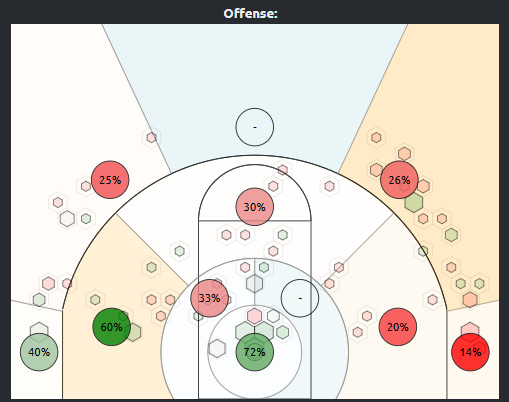
At 22.7 on 66 three-point attempts in two seasons, the returns are not good, and that’s an understatement. But on the other hand, how much should 1.5 attempts per game tell you? It should never be the entire story. He shot 31.6% on over three attempts in the FIBA AmeriCup in 2021. That’s a while ago, but he has shown his volume and a decent jumper throughout his young career. Overall, I’m focusing on the mechanics, shooting form and the consistency of it to see how much his jumper can develop in the next few years. Considering a more low-usage role early in his career, being a consistent shooter will determine the most of how many minutes NBA team can give him.
The first play has Tucker spead the floor after the opponent hard-hedged to give him space to benefit from the extra space. He pivotted strongly with his left, bent his knees but entered his shooting motion without positioning his body fully at 180 degrees of the basket. We see a similar outcome in the second play where Tucker steps aside to be in the passer’s angle but was completely stationary without bending his knees. Mostly because he already had a hand in his face and less time to shoot. He’s holding the ball inwards, pressuring his shoulders a bit instead of lowering them more.
The third play has him wide-open in the corner. He’s still pressuring the shoulders but shows a much more fluid release. Overall, he looks uncomfortable shooting because of him elevating for his jumper while the ball is already above his shoulders. He has to rise up for his jumper earlier to maximize the fluidity. That’s the biggest area where he can gain a better jumper. The fourth possession shows another of this example. Overall, the shooting potential doesn’t look good but the process makes sense. He’s setting his feet. That part of is not the issue and makes further improvement imminent. But there’s not enough to make it feasible that he’ll be a good shooter at the next level.
Self-creation out of pick-and-roll and closeouts
At a 76.5 finishing rate at the rim excluding his 17 dunks, the returns are tremendous. Tucker’s stood out with strong scoring touch in high school, and despite lower volume that’s been the case in college as well. He’s mostly been a play-finisher with 84.6 of his rim-makes being assisted on, which is a vital part of the context. That’s because the self-creation hasn’t looked convincing this season. The first play has him milk the clock and eventually lead to the live-ball turnover after he slipped and fell. The second possession has him create the angle for the midrange jumper. Overall, the last step wasn’t good and led to the unbalanced shot.
He’s not convincingly using his first step, with closed angles leading to him finding his shot in a more isolated style. The third play led to a bad three-point jumper whereas, despite the make, the fourth possession had him milk the clock again for a few seconds. NBA teams try to maximize their possessions in a game, and therefore quick ball movement is essential. That’s the main area for him to focus on. The touch around the basket is solid, but the execution as a self-creator hasn’t been convincing in his sophomore year.
Passing, ball-moving, and playmaking
At 23 assists to 23 turnovers in two seasons, the small sample size doesn’t make it possible to use the numbers for any conclusions. As mentioned above, we see a more isolation-style when Tucker’s handling the ball and creating for himself. Overall, he’ll mostly play as a ball mover while he must work on being more of a secondary creator for others by executing passing reads consistently. The first play has him push the pace in transition to where he stays calm and simply reads and reacts before hitting the strong side elbow for the open three. The second possession has him keep the play alive with his offensive rebounding to where he again calmly looks around him and executes the pass to the elbow for the open three-pointer.
Tucker’s been a ball-mover at Washington for most of the time, with the third and fourth plays showing examples. The best part is that he’s focused and executes quickly on that end with him using the fake to see over the defense before the good post-entry pass in the fifth possession below. He’s sticking to his boundaries and has shown promise with how well he’s seeing open teammates as a ball-mover, executing quickly. The lack of creation off the dribble is mostly context to where Tucker will have to prove that part of his game in team workouts.
NBA Draft Projection
It’s interesting to see Tucker going all-in by staying in the 2026 NBA Draft. And now—after doing my research and film study—it’s easier to see why. Defensively he’s a high-feel prospect with a proven value in how much the intangibles are good. He’s physical while still having to grow into his body. Rotation-wise and recognizing angles while filling in positioning excellent that’s the part where Tucker has the most value to offer as he’ll still be a teenager on draft night.
The other side of the coin is the lack of a reliable jumper and ball handling to offer. Overall, the touch around the rim is fantastic but that’s mostly for him what he has to rely on in the NBA. He’s a ball-mover and a limited self-creating scorer and that pressure on a team’s offensive rating is the value-dropper in his profile.
Overall, I’ll always bet on defensive standouts compared to offensive standouts. That’s because Tucker needs to grow into a role and his defense will put him on the floor. If he’s a average shooter early in his career, we’ll see him play minutes. I expect him to be a second-rounder in the 2026 NBA Draft, being selected after the 40s and eventually signing a two-way contract.
At over 350 (!) articles in 3.5 years, Ersin’s NBA Draft Newsletter is your go-to for draft content. Make sure you subscribe at $6 per month/$60 per year for much more!